- Customer success story
Inside Reality AG: Existing buildings in 3D, same day
Same day
from the site visit scan to a model in the icRoom
phone scan for early planning questions, laser scanning for millimeter work
captures the space on site, without waiting for an external laser scan
people review one model together in the icRoom, without VR glasses
About Inside Reality AG

Inside Reality AG makes immersive group experiences that run on web technology, online and offline. Instead of handing out headsets, the company projects onto the walls of a room, so a whole team sees the same thing at the same time. They call it VR without glasses. Products include the icRoom immersive space, the Teleport shared workspace, and visualization and illustration services. Inside Reality AG has been recognized at the Digital Economy Award for high-quality digital selling and an intuitive user experience. It works with public offices, architects and planners, public transport, retail, trade fairs, banks, and research and health organizations.
INDUSTRY
3D web visualization and immersive collaboration
COMPANY SIZE
12 employees
LOCATION
Liestal, Switzerland
Immersive project reviews without VR glasses
Inside Reality AG solves a language problem. On a building project, planners, engineers and architects work with 3D models every day. The people who own the building, pay for it or will work in it usually do not. Everyone is talking about the same project, but not in the same terms.
The fix is to put them all inside the same picture. A typical icRoom measures about 5 × 5 × 5 meters. Inside Reality AG projects onto the walls from ceiling to floor, and a team of five to seven people sits together at a desk and shares the experience. Nobody wears glasses.
Chris Henn is the CTO. His job is everything that happens before that moment: taking models from wherever they come from, in whatever format, and getting them ready so a group can walk in and make a decision. How a building is captured in the first place sets the pace for everything after it.
Why laser scanning slowed down early planning
Getting an existing building into an immersive room used to start with a professional laser scan. Someone recorded the space as a point cloud, the data was loaded into whatever software the project was using, and the individual parts were modeled again by hand.
It worked, and it delivered millimeter precision where that was really needed. But it was slow. As Chris Henn describes it, the old route meant several steps, several people, several data handovers, and a modeling and interpretation stage in the middle.
There was another problem. Inside Reality AG did not do the capture itself. The scan came from a client or an engineering partner, so the clock started somewhere else and the visualization team had to wait. For the questions that come up right at the beginning, when the point is simply to find out whether an idea works, that was a heavy way to start.
Phone scan or laser scan? When centimeter accuracy is enough
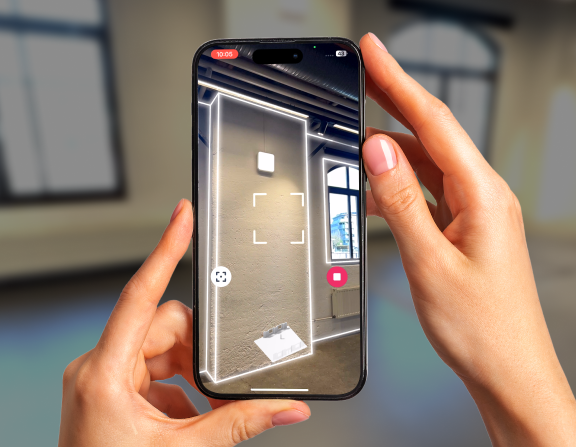
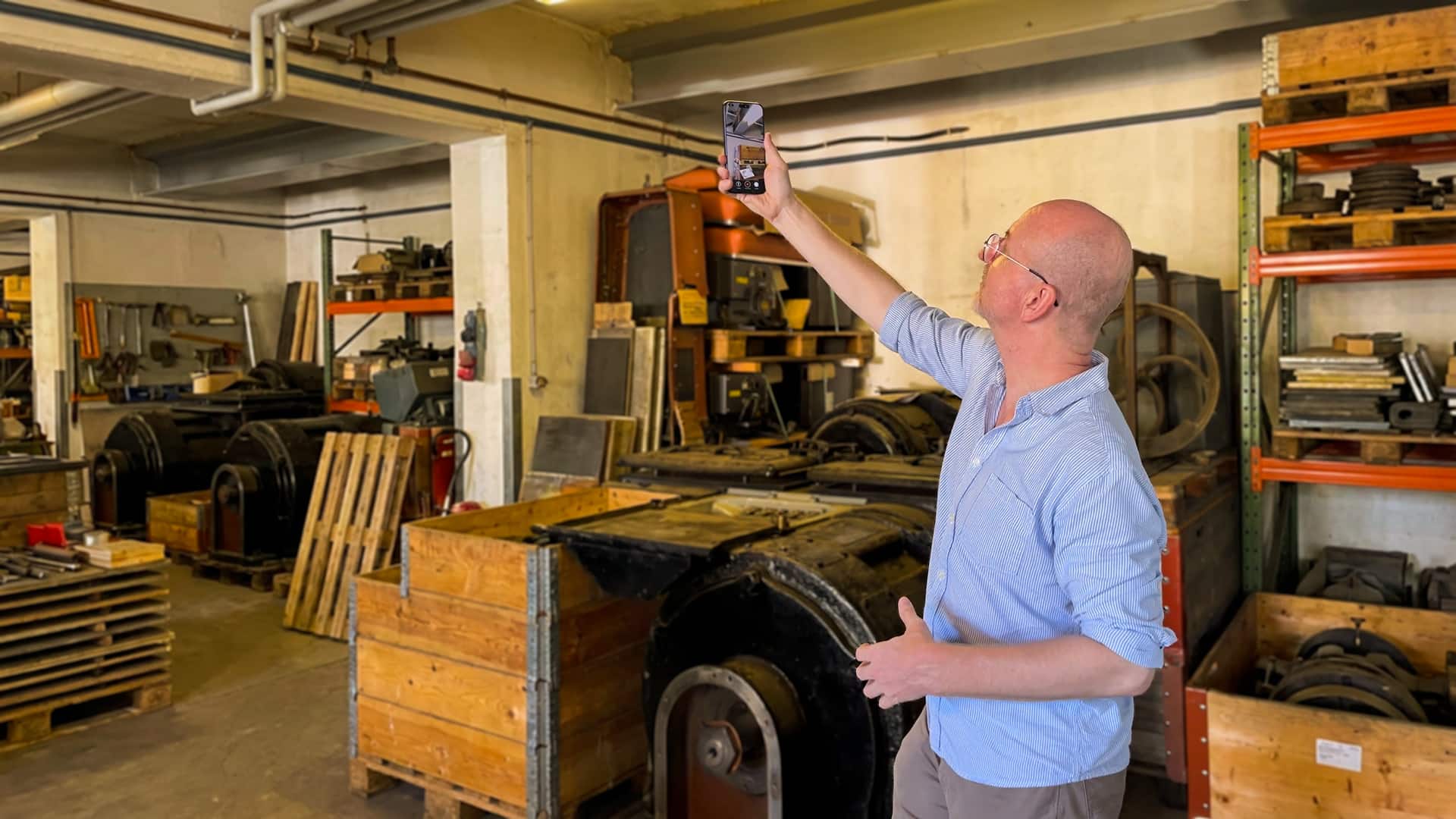
Now an existing space can arrive as a scan taken with Metaroom on a LiDAR-enabled iPhone Pro or iPad Pro during a normal site visit. Metaroom is a professional 3D scanning platform for architects, engineers and building trades. The scan is exported as an IFC file, and from there most of the work on the Inside Reality AG platform runs automatically.
- The scan is combined with the models the project already has, and each one is placed correctly inside the next. The building goes into its surroundings too, so the client sees the site, the building and the rooms as one.
- The Inside Reality AG platform handles over 40 native file formats, so models from different sources sit together in a single scene.
- The same source produces two kinds of output. Technical models go into BIM sessions, where the disciplines work together and check for clashes. More realistic views with proper materials go to the people who will actually use the building.
- Only light cleanup is needed. The Inside Reality AG team removes furniture, leftover equipment and renovation debris, so the scene shows how the space will be used rather than how it looked on the day of the scan. Beyond that, very little has to change.
Inside Reality AG is clear about the limits. A phone scan is accurate to centimeters, not millimeters, so it does not replace laser scanning where that level of precision is truly required. What it does is cover the large majority of everyday questions at a much lower cost in time and money. Chris Henn calls it a classic 80/20 situation, and says it is what most people will really go for.

| Scanning an existing building with Metaroom to create a 3D model
From site visit to icRoom the same day
The main change is how soon the work can begin. What used to take several steps, several people and a remodeling stage can now be scanned and used almost right away, with only the small changes needed to show the room in its future state. Chris Henn calls it a game changer: you can scan and start working.
Once the model is in the icRoom, it does more than show the building. Inside Reality AG uses visualization to bring different people to the same table, and the group is usually mixed: experts who read building models daily, owners who are not technical, and future employees who will work in the space. Because the model can be viewed from every angle, they can check practical things together: how easy the building is to reach, how safe it feels, what is visible from where, and whether the design works.
The point is not the picture. It is the conversation. Even specialists in neighboring fields do not always understand each other, and seeing the same environment removes misunderstandings. As Chris Henn puts it, a model you can sit inside answers the questions people already had and, more interestingly, helps them find the questions they forgot to ask. That turns it into a decision tool rather than just another piece of software.

| Reviewing the 3D model inside the icRoom at Inside Reality AG
Existing buildings in 3D while decisions are still open
Inside Reality AG has always needed two things: good geometry, fast, and a group of people in front of it. The second part has been solved for years. A scan taken with an iPhone Pro now takes most of the delay out of the first.
The result: an existing building can be captured during an ordinary site visit and shown at full size to the people who will own it and work in it, while the decisions are still open, in a language everyone in the room understands.
Inside Reality AG
“What makes this process unique is that I can do it with my phone. I just pull it out, scan, and start working. I can answer a lot of questions right away, with a much lower investment of time and money than before.”

Chris Henn
Chief Technology Officer, Inside Reality AG